Always Improving
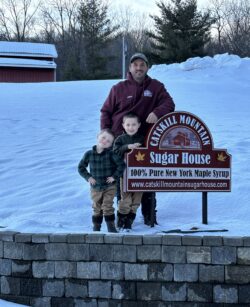
For John Garigliano of Catskill Mountain Sugarhouse, “Always Improving” is not a slogan. It is a survival
strategy. Located in Grahamsville, New York, John operates 56,000 taps and has been in business since
2009. While he has been around maple his entire life, 2009 marked the first year he approached sugaring
strictly from a business perspective. Since then, one thing has remained constant: nothing in maple
production is ever constant.
IMPROVEMENT IN A BUSINESS WITH NO CONSTANTS
Weather patterns shift. Workforce availability changes. Sap flow
fluctuates. Equipment evolves. John believes improvement begin with accepting that perfection is temporary. “You can never make
it perfect,” he explains. “If you made it perfect for this year, next year is going to be different.”
Each season brings new challenges. Some years’ temperatures do not get cold enough to tap. Other years refuse to warm up.
In his region, production often begins in January, with full runs by mid-February and completion by late March. But even those
benchmarks can change without warning.
For John, always improving means reviewing every season carefully, identifying weak points, and making deliberate,
incremental upgrades. It is about choosing the right battles and strengthening one area at a time.
STAYING AHEAD INSTEAD OF CATCHING UP
In today’s maple industry, reacting is not enough. John believes producers must plan two and three years ahead.
“Everything in the world is changing,” he says. “You have to be ready to change with it.”
He has observed that the more experience he gains, the more he realizes how much remains uncertain. That awareness fuels his
forward planning. Market demand for maple syrup remains strong but meeting that demand requires preparation and foresight.
Rather than waiting for pressure to build, John invests in infrastructure and capacity before it becomes urgent. This
approach allows him to remain steady when others are scrambling.
DRIVEN BY CUSTOMERS: ORGANIC AND MARKET ADAPTATION
Catskill Mountain Sugarhouse sells very little wholesale syrup. The majority goes directly to customers. That direct relationship
shapes many of John’s decisions.
His move toward organic production was prompted by a large customer request. His philosophy is simple: “Whatever you need, I’ll do.”
Although maple syrup is inherently a natural product, organic certification requires rigorous documentation, accountability,
and discipline. For John, that structure reinforces higher internal standards. The operation is also certified kosher, including kosher for
Passover, further demonstrating commitment to customer needs.
“It’s easy to cut corners,” he notes. “These programs make you hold yourself to a higher standard.”
Market adaptation, for John, is not about chasing trends. It is about strengthening long-term relationships and building trust.
STRATEGIC INVESTMENT IN 2025
In 2025, John made significant capital investments in new equipment. The decision was not impulsive. It was strategic.
Workforce availability has become increasingly limited, and automation paired with larger, more efficient infrastructure helps
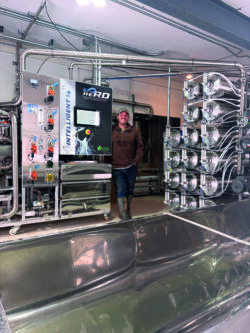
offset that challenge. The operation added two 10-post 30+ Automated HERO RO systems and one 16-post 30+ Automated
HERO RO, significantly expanding concentration capacity during heavy sap runs. Sap storage and handling were also upgraded
with two CDL 12’×20’ silos with 16,000 US gallon capacity, helping stabilize flow during peak collection periods.
Filtration and transfer efficiency were improved through the addition of a 167 GPM stainless steel glass bead filter system,
supported by thirteen CDL 5.5 HP three-phase screw pumps.
Together, these upgrades allow the operation to run more efficiently with fewer people. Automation, in particular, enables
John to manage multiple processes simultaneously. Modern systems can run at peak efficiency without constant manual oversight, a capability that becomes critical during heavy sap runs when delays can quickly snowball.
Beyond productivity, automation has improved sustainability at a personal level. As a father of two young children, John values every hour he can reclaim.
“When I started, I didn’t have a family. Now I do,” he says. “The
new machines help me spend a little more time at home. It’s not much, but everything is something.”
RISK VERSUS OPPORTUNITY
Every capital investment carries a risk. John evaluates decisions after each season by asking a simple question: where did we
struggle?
In 2025, one major challenge was trucking logistics. Instead of purchasing additional trucks, he restructured production by
moving a facility closer to the sap source. By improving logistics rather than expanding fleet size, he strengthened efficiency and
reduced a weak link in the system.
For John, investing in the future is not optional. Continuous reinvestment in equipment, infrastructure, and quality is essential
to remaining competitive.
“You have to continuously be investing in yourself and your future,” he explains.
WHAT SEPARATES FORWARD THINKING PRODUCERS
According to John, the difference between thriving and struggling operations often comes down to preparation and mindset.
Forward thinking producers treat maple as a full-time business. They anticipate problems instead of reacting to them. They
commit to the work required not only to survive a season, but to strengthen the business long term.
Experience plays a role, but so does discipline. The larger an operation grows, the more intentional management must become.
Overlooking small details or constantly playing catch up can prevent growth.
“It comes from knowledge and being prepared for when things happen,” he says.
OPPORTUNITY IN THE INDUSTRY
Despite challenges, John sees tremendous opportunity in maple.
Global demand remains strong. Advances in technology and research allow producers to increase output without necessarily
expanding acreage. Today, efficiency improvements can unlock additional production from existing woods.
“You don’t have to go find another sugarbush,” he explains. “With what’s available now, you can make more with what you already
have.”
In agriculture, that position is rare. Many sectors struggle with oversupply. Maple producers, by contrast, benefit from consistent
demand and product loyalty.
THE REWARD
When asked about his favorite part of the job, John does not mention expansion or equipment.
“It’s knowing you did a good job,” he says.
Sugaring is demanding work. It requires long hours, physical endurance, financial risk, and relentless problem solving. But for
those willing to commit to constant improvement, the reward is deeply satisfying.
There is a reason not everyone chooses this path.
And there is a reason John continues to push forward, season
after season.
Always improving.