Boiling Centers: Much More Than a Trend
Every generation brings its own wave of change, and the maple industry is no exception. The next
generation is stepping in not to reject the past, but to redefine it and structure operations differently.
Today, several organizational models are emerging across the
industry. Each operation evolves according to its reality, its territory,
and its vision. Among these approaches, some producers are
choosing to organize their production around centralized boiling
centers. This model is generating strong interest and clearly
reflects the ongoing evolution of maple production.
THE CÔTÉ FAMILY
For Sébastien and Émilie Côté of Roxton Pond in the Eastern
Townships, maple production was never a casual choice. It is a
continuation of family tradition.
Involved in the family sugar bush since childhood and working
full-time since 2007, they have built their operation on handson
experience, supported by CDL’s expert team from both the
Roxton store and head office.
Today, together with their family, they operate two businesses
totaling nearly 90,000 taps, along with an additional 65,000 taps
through leasing, sap purchasing, or custom boiling. In total, sap
from more than 155,000 taps is processed through their boiling
center.
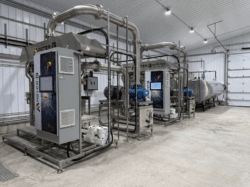
Their installation reflects their ambition: three fully electric,
automated Master-E evaporators, one oil-fired Master, three
21-post heRO intelligent concentrators, and a level of organization
that allows just two people to manage the entire operation. On
peak days, they can produce up to 510 gallons of syrup, or
approximately 15 barrels per hour.
WHY CHOOSE A BOILING CENTER?
For Sébastien and his brother-in-law Mikael, the reasoning is
straightforward. Costs are rising, new quotas are being allocated
to emerging producers, and smaller sugar bushes of 3,000 to
4,000 taps often lack the means or the desire to build a complete
sugarhouse. Investing in land and tapping trees is one thing.
Building a sugarhouse and installing a concentrator and evaporator
is another. “Boiling centers are the way of the future,” Sébastien explains.
According to the family, some producers have no interest in
operating independently, while others prefer to learn before
making major investments. In both cases, the boiling center
becomes a form of support, whether temporary or long-term.
SCALING PRODUCTION
The result is optimized production supported by a stable team.
Several foreign workers have been with the operation for seven
years, steadily building confidence and expertise. For Mikael,
seeing their growth within the company is a source of pride.
Automation has also changed the pace of the season. Nights are
no longer spent constantly monitoring operations. They can rest
and only respond when needed. The rhythm is more structured
and significantly less exhausting.
The Côté family is now aiming for 200,000 taps, while remaining
committed to what matters most: family.
THE PLOURDE FAMILY
For Marc-André Plourde of Érablière Yves Plourde in New
Brunswick, taking over the family business was never a question.
It was a given. A third-generation producer, he recently added
35,000 taps to an existing 80,000, with another 20,000 planned
for next year. The operation will soon exceed 135,000 taps, with
a clear objective of reaching 300,000.
Growth, for him, is instinctive. “Grow. Improve. Optimize. It’s a
disease,” he jokes.
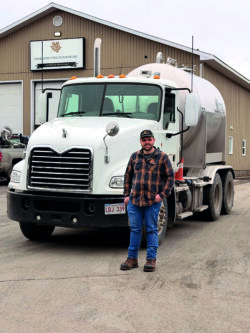
THINKING BIGGER
The family sugarhouse could no longer support expansion.
Bringing in the required three-phase power for new installations
was not feasible. As a result, Marc-André relocated his boiling
center to an industrial park, where electrical capacity allows for
future growth.
The building seemed almost purpose-built. During the first visit,
accompanied by CDL representatives Samuel Beaulé and Jacques
St-Pierre, measurements confirmed that everything fit perfectly.
“It couldn’t go wrong. Everything fit,” he recalls with a laugh.
The center was designed from the outset to accommodate up to
six Master-E units, two of which were already operational during
the 2026 season. The installation includes nearly 700 vacuum
sensors throughout the tubing network. At external sites, two
21-post concentrators handle sap concentration.
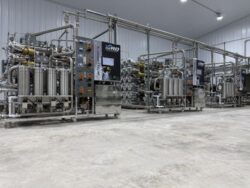
At the boiling center itself, the setup includes a 10-post heRO
intelligent concentrator, two Master-E evaporators, two
20,000-gallon silos, two syrup presses, a dynamic mixer, and
insulated tanks for both cold concentrate and hot syrup.
WHY MAKE THE SHIFT?
Marc-André chose this model to continue growing despite labor
shortages, rising costs, and syrup prices that do not always
keep pace.
“If technology hadn’t evolved, I would have stopped at 60,000
taps,” he explains.
Today, with ten workers in the woods and just one in the
sugarhouse, he maintains an average yield of 4.9 pounds per
tap over the past ten years. Technology allows him to keep his
workforce where it matters most: in the woods, not cleaning pans.
The boiling center also provides strategic flexibility. He can acquire
new sugar bushes without concern for existing infrastructure,
transport concentrate instead of raw sap, centralize operations,
and reduce travel time.
His current challenge is clear: continue growing without
compromising yield.
AN INDUSTRY IN TRANSITION
In both cases, the conclusion is the same. The maple industry is
undergoing significant transformation. Labor is scarce. Quotas
are evolving. The next generation brings a different vision. Maple
operations are no longer developed as they were 20 years ago.
Boiling centers are not simply larger buildings. They are strategic
decisions. They offer a way to structure growth, centralize
operations, and better deploy labor. Above all, they represent a
commitment to optimizing every gallon produced.