CDL Intelligence for 10,000 Taps and Under: Everyday Challenges
Sugaring season is never completely simple. It requires energy, time, and constant attention. More often
than not, it’s not the major issues that wear producers down, but the small, recurring frustrations that
come back day after day.
Those areas you always keep an extra eye on.
Those pump stations that require repeated trips.
Those tanks that stay on your mind even after leaving the
sugarhouse.
Those extra checks you do “just in case.”
It’s not dramatic but it adds up.
Over time, these frustrations chip away at your time, your energy,
and most importantly, your peace of mind.
AN ACCESSIBLE STARTING POINT
We often think 4.0 is reserved for large-scale operations. In
reality, for most producers, it starts much simpler: by solving
one concrete issue. Not all of them. Just one.
The first step is to clearly identify it. Think back to your last sap run.
When did frustration kick in? Where did you lose unnecessary
time? What forced you to intervene more often than needed?
That’s usually where the issue lies.
Once identified, the problem already feels more manageable.
Then it’s time to discuss it with your CDL representative, whether
the goal is reducing travel, gaining real-time visibility, avoiding
surprises, or stabilizing a more sensitive area.
SUPPORT WHEN IT MATTERS
If needed, CDL’s advisory team can come on-site to assess your
situation: network observation, targeted measurements, and
operational analysis. The goal isn’t to overhaul everything, it’s to
understand what will truly simplify your day-to-day operations.
SMALL ADDITIONS, BIG IMPACT
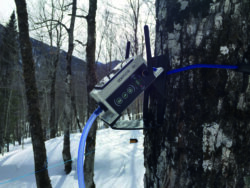
In practical terms, this might mean adding a vacuum sensor in a
specific sector to quickly detect variations, installing a motorized
valve to reduce trips to remote stations, or adding a level sensor
to prevent tank overflows.
The system is designed to integrate naturally into your workflow,
with support and training to ensure CDL Intelligence remains a
simple, effective tool not technology for the sake of technology,
but clarity and control.
The results are quickly noticeable:
• Fewer unnecessary trips
• Faster, more precise interventions
• Greater confidence when leaving the sugarhouse
• Less “blind” management
Take the example of Mr. Roy, a maple producer from the Beauce
region with a 3,000-tap operation. In the woods, locating leaks
and monitoring the tubing network represented a significant
challenge. Thanks to sensors installed at the ends of the mainlines,
he can now quickly identify problem areas, go directly to the
right locations, and better understand how his network behaves,
particularly during thawing periods and when adjustments need
to be made to the lines.
At the sugarhouse and pumping station, frequent travel was
also an issue due to the distance between the installations. The
addition of remote start controls for the vacuum and transfer
pumps, tank-level sensors, and cameras now allows him to
monitor his operations at all times, directly from his phone.
This example shows that it is not necessary to automate
everything to achieve tangible results. In Mr. Roy’s case, the CDL
Intelligence system allows him to improve efficiency, reduce travel,
and respond more quickly. He can therefore continue working in
the woods while the equipment is running, with greater peace
of mind and without worrying about overflows.
REGAINING CONTROL
What surprises most producers isn’t the technology it’s the peace
of mind. The ability to stay in control, even when off-site.
After solving one issue, something shifts. 4.0 no longer feels
intimidating it becomes tangible and accessible. Then comes a
second improvement. Then a third.
Not to automate everything, but to simplify everyday operations.
IT ALL STARTS WITH ONE
Modernizing your sugarbush isn’t about following trends or trying
to outgrow your neighbors. It’s about choosing not to let the same
issue affect your peace of mind season after season when there’s
a simpler way to manage it.
Sometimes, it all starts with fixing just one.
ANDRÉ FONTAINE, Bellechasse, QC
10,000 taps
For André, the main challenge was quickly locating leaks in his network.
With monitoring in place, he now knows exactly where to intervene, without having to walk the entire system. The result: fewer trips,
faster interventions, and significant time savings, especially valuable in a context where labor is harder to find.