From Idea to Innovation: The Genesis of the Master-E
As part of CDL’s research and development team, I have been involved from the earliest reflections
that led to the creation of the fully electric, automated Master-E evaporator.
Its story begins around 2015. At first glance, the idea was simple:
reduce the energy and time required for evaporation. From a
technical standpoint, the initial results were promising. However, a
limitation quickly became clear. The market for such a technology
was too small to justify large scale development, and the project
was put on hold.
WHEN THE INDUSTRY CHANGES, IDEAS RETURN
Over time, the maple industry evolved. Sugar bushes expanded,
installations modernized, and buildings became increasingly
electrified. More importantly, the human reality shifted. Labor
shortages became a growing challenge, requiring producers to do
more with fewer resources. At the same time, a new generation
emerged with different expectations: greater control, increased
automation, and less reliance on manual operations.
In this context, the idea resurfaced, but in a new form. What if
electricity could become not only an energy source, but also a
control lever?
THE FIRST TRIALS
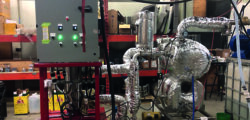
From an engineering perspective, development began in 2016
with a series of prototype tests conducted in an isolated area
of our Ste-Claire facility. Alongside Maurice Beauchamp, Sylvain
Côté, and Steve O’Farrell, we took an exploratory approach to
designing an energy efficient electric evaporator with the lowest
possible operating cost.
The initial concepts were numerous. Results were mixed, but each
prototype provided valuable insights. One principle ultimately
reshaped our approach: the falling film method, already used
in other industries. Small scale tests delivered surprisingly
strong performance, confirming its potential and leading to the
development of a new prototype.
THE TURNING POINT: INTEGRATING VACUUM
Under vacuum conditions, water boils at a lower temperature.
Integrating this principle into the core of the system marked a
turning point.
Evaporation dynamics changed completely. Temperatures
decreased, thermal reactions shifted, and most importantly,
the resulting product evolved. Testing revealed an unexpected
outcome: depending on the parameters, it became possible
to produce not only syrup, but also a maple concentrate with
BUILDING BALANCE
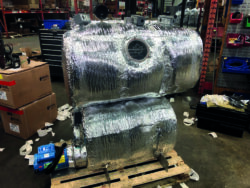
As development progressed, eventually reaching a fifth prototype
close to the commercial model, a major challenge emerged. As
Serge Tanguay, Executive Director of Business Development,
explains, the challenge was not simply boiling differently, but ensuring
that multiple complex systems worked together seamlessly.
Vapor compression, vacuum generation, thermal management,
flow control, and product stabilization all had to function as one
integrated system. Each component influenced the others. The
challenge became one of balance. We needed to develop a
technology capable of delivering a stable, consistent product at
the desired Brix level, while remaining reliable and reproducible
in real production environments. This is where the Master-E
represents a major breakthrough. For the first time, maple
producers can precisely control the final Brix level with an
unprecedented degree of accuracy.
A CONTROLLED MARKET INTRODUCTION
Recognizing the innovative and demanding nature of the
technology, CDL made a strategic decision to introduce it
gradually. Rather than scaling production immediately, we chose
to work with a limited number of producers willing to invest, test,
and actively participate in advancing maple production.
To support this approach, CDL established a Technology Center
in St-Henri (QC), a true applied research environment within a
working sugar bush. This allows our team to test, validate, and
demonstrate the technology under real operating conditions.
LEARNING FROM THE FIELD
Like any major innovation, the early years brought challenges.
Despite rigorous engineering validation, certain components
did not always perform as expected once deployed in real world
conditions.
As early as the first season, a significant recall was required. In the
second year, issues arose with Brix measurement technology.
These adjustments demanded adaptability from both customers
and our internal teams. Producers had to learn new operating
methods, while our teams implemented corrections on installed
units and refined designs for future production.
Across engineering, sales, technical service, and procurement,
the entire organization mobilized to find solutions.
What truly defines this project, however, is the response from
producers. Year after year, they remained engaged, moving from
understanding to confidence, and ultimately to satisfaction as
improvements were implemented.
By the third year, the technology reached a level of maturity that
confirmed its full potential. Even today, the product continues
to evolve. This progress would not have been possible without
these exceptional customers, true partners who demonstrated
trust, commitment, and collaboration.
REDEFINING THE MAPLE PRODUCT
Throughout development, a major discovery emerged. Originally
designed to avoid caramelization, the Master-E ultimately made it
possible to achieve something more ambitious: producing a High
Brix Concentrate at 66 Brix without reaching traditional boiling
temperatures, while preserving the full properties of maple sap.
According to Serge Tanguay, this capability opens the door to
new applications and significant growth potential in international
demand in the years ahead.
TOWARD A MORE ACCESSIBLE VERSION
Over time, another realization emerged. In North America, nearly
30% of maple production comes from operations with 10,000 taps
or fewer a segment far from marginal. These producers often
share a similar reality: limited time, reduced labor, but the same
level of passion. For them, spending entire nights monitoring a
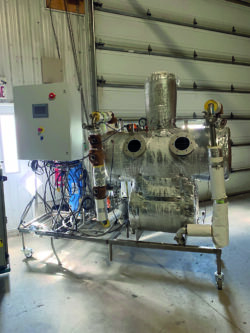
boiler is no longer an option. This led to the development of a
more compact and accessible version of the Master-E, designed
to deliver the same technological foundation at a smaller scale.
The Master-E 40 HP, launched at the Open House in May 2025,
requires less energy, operating on a 200-amp, 240-volt power
supply, making it more accessible to producers with 10,000 taps
or fewer.
A CONTINUITY DRIVEN BY EVOLUTION
As you can see, and this is the beauty of research and
development, an idea can emerge quietly, go through periods
of dormancy, and then return in a new form. It evolves, becomes
refined, and eventually fully blossoms… transforming a method
once thought to be rooted in tradition.