Making Precise Decisions with CDL Intelligence: The Role of Data in a Sugarbush
Everyone would love to predict exactly when the next sap flow will happen. To pinpoint, every time, which mainline is leaking. To know a tank will overflow before the first drop even hits the ground. We all dream of having that sixth sense that never gets it wrong.
But in reality, relying solely on instinct is a bit like going all in in poker before even seeing your hand. It’s not a strategy, it’s a gamble. And a sugaring season is not something you leave to chance.
WHERE LOSSES HIDE
In the woods, problems aren’t always obvious. A leak on a secondary line. A 5/16” line pulled out by a deer. Tubing chewed by a squirrel. A subtle break after an ice storm. Nothing dramatic. Nothing that immediately stands out.
At the extractor, the vacuum may look good. The gauge shows a reassuring number. Yet a specific section of the system may be losing two or three inches of mercury. Not enough to trigger alarm
bells, just enough to quietly reduce yield across hundreds of taps.
Every passing hour becomes another gamble.
THAT IS WHERE 4.0 CHANGES THE GAME.
With sector-based sensors, decisions are no longer based on general impressions. Vacuum levels can be compared in real time. You can see that one section reaches its target vacuum more slowly.
You notice that a specific zone reacts differently during a thaw. You detect unusual variations during a strong run.
Instead of walking the entire bush “just in case,” you go where the data points.
WHERE IT ALL HAPPENS
In the sugarhouse, the same logic applies.
A tank overflowing isn’t bad luck, it’s a lack of the right information at the right time. A pump starting too early. A transfer poorly synchronized. A concentrator shutting down at 2 a.m. without anyone knowing.
With real-time monitoring, these situations are no longer surprises. Level sensors prevent overflow. Temperature probes signal freezing risks. Analyzing operating cycles reveals anomalies before they turn into breakdowns.
You are no longer guessing. You are measuring.
A SUGARBUSH THAT COMMUNICATES
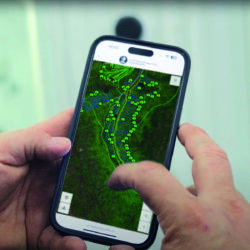
What sets the CDL approach apart is that information isn’t isolated within a single machine. Equipment can be accessed remotely through one unified application.
Producers can see what’s happening in their sugarhouse, pumping stations, or specific sections of their network, even when they are not on-site.
And these systems aren’t static. Through remote updates, equipment can evolve, gain new features, and improve performance without requiring physical modifications.
The vision goes even further. Work is underway to develop sensors connected directly to 5/16” lines, with the goal of making them accessible at scale and increasing their presence throughout the
network. Other sensors in development could help pinpoint the exact location of a problem and even identify its nature,
whether freezing, slope issues, or leaks within the system.
Ultimately, the goal is full interconnectivity between equipment. Systems will be able to share data, communicate with each other, and automatically adjust to maintain optimal operating conditions.
LESS GUESSWORK IN THE SEASON
4.0 doesn’t replace a producer’s instinct. It removes the guesswork. You can’t control wildlife, and certainly not the weather. But you can choose not to manage your season like a coin toss.
Poker is for Saturday night.
A sugarbush is managed with information.
And when you have the right data in hand, it’s no longer a question of luck.
It’s the best hand at the table.