Simplifying Forest Installation with the Mobile Pumping Station

Every sugarbush is unique. Some extend across accessible, well-developed terrain. Others run through
more remote areas, wetlands, or zones where conditions change from year to year. Over time, mainlines
evolve, needs shift, and the realities of the land sometimes impose their own rules.
In this context, installing a pumping station often becomes a
complex, and sometimes evolving, project. Beyond the equipment
itself, producers must plan for a concrete slab, a building, access
to electricity, and the required construction permits. These
steps require time, planning, and resources. Once installed, the
station becomes permanent infrastructure, difficult to modify
and impossible to move.
For many producers, this reality can slow certain projects or limit
expansion opportunities in more challenging areas.
TODAY, A NEW APPROACH MAKES THIS STEP MUCH SIMPLER.
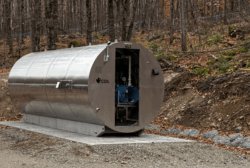
The CDL Mobile Pumping Station, an innovative patent-pending
solution, is a turnkey system fully prefabricated at the factory,
delivered directly to the sugarbush and ready for connection.
Upon arrival on site, it can be installed quickly without permanent
construction, without a concrete slab, and without the need for
a building permit.
Each station is fully equipped to ensure reliable and autonomous
operation. It integrates the vacuum pump, extractor, moisture
trap, transfer pump, and all the components required for proper
operation. Insulation, lighting, ventilation, heating, and the electrical
panel are all installed within the structure, ensuring optimal
conditions regardless of outdoor weather.
This design significantly reduces installation time. Instead of
planning and building a station on site, the unit simply needs
to be positioned on compacted ground and connected to the
system. Time spent in the field is minimized, allowing for fast and
efficient startup.
BUT BEYOND INSTALLATION SIMPLICITY, IT IS THE FLEXIBILITY
THAT TRULY SETS THIS APPROACH APART
Unlike a permanent station, the mobile station can be moved
when needed. It can follow the development of the sugarbush,
be repositioned in a new sector, or relocated if terrain conditions
require it. This adaptability becomes particularly valuable in
flood-prone areas or on leased land, where building permanent
infrastructure is not always desirable.
This mobility also helps reduce risks related to environmental
changes and unforeseen circumstances. Producers maintain the
freedom to adjust their installation as their sugarbush evolves,
without being constrained by permanent decisions.
The station is compatible with CDL equipment and can be
integrated into a CDL Intelligence management system, allowing
precise and reliable monitoring of operations. It is also available
with or without a tank, depending on the desired configuration.
Over the years, maple production has evolved, and installations
must now respond to more diverse realities than ever before.
Producers are looking for solutions that are efficient, reliable, and
adapted to their land.
CDL is proud to offer solutions designed to simplify installation,
reduce constraints, and adapt to the realities of the terrain.
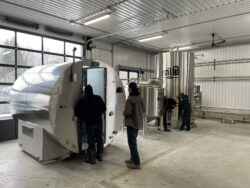
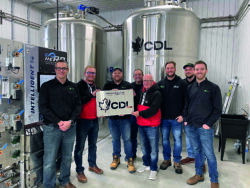
Patrick Côté, Érablière MMPS Côté
Mobile pumping station with tank
“Installation is really simple. The station arrives by trailer and is
placed directly in the desired location. Depending on the terrain,
a few adjustments may be needed, but nothing complex. All
that’s left is to make the connections. We also appreciate that
the station is compatible with CDL Intelligence and that it offers
a complete, ready-to-use solution.
Jonathan Laperle , Maple Sport
Mobile pumping station without tank
“A simple, fast, and well designed installation. What we appreciated
most was how easy it was to install. Whether it was connecting it
to the rest of the system or positioning the station exactly where
we needed it, everything was straightforward.
Since we chose the model without a tank, the station is very
compact and easy to move. We only had to slightly adjust the
ground to create a slope and level it no need to pour a concrete
pad.
The station arrives already equipped with the essential
components, such as the electrical panel and air exchanger. All
that was left was to make the connections. In use, everything is
simple, efficient, and intuitive.”