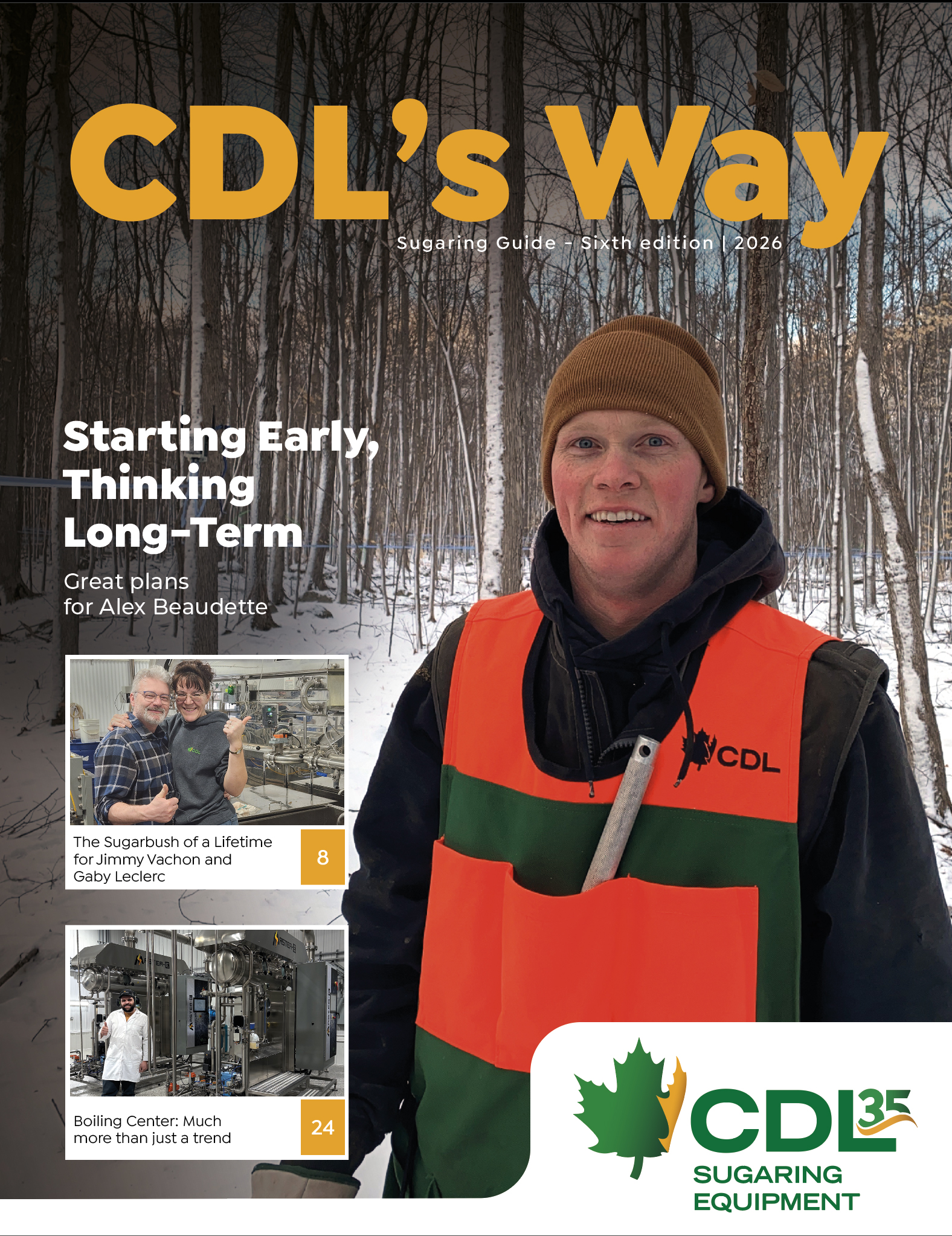
Starting Early, Thinking Long-Term
For Alex Beaudette of Good Valley Maple in Eastern Ontario, maple production did not begin as a family
tradition passed down through the sugarhouse. It began with curiosity, opportunity, and the confidence
of a 14-year-old willing to invest in something bigger than himself.
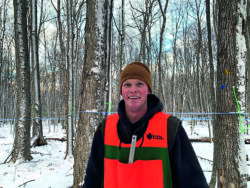
Today, Alex operates approximately 2,000 taps near Cornwall,
Ontario. His first production season was in 2014 with just 20
buckets. The path from those first buckets to a growth-focused,
technology-driven operation has been built on steady learning,
strategic equipment decisions, and a long-term vision that
continues to expand.
A SPARK IN THE BUSH
Maple was not originally the plan. Alex is first and foremost a dairy
farmer. The family farm centers on milk production, and his daily
work revolves around livestock and crop farming. But one day in
the bush, while cutting cedar fence posts, he noticed something
that shifted his direction.
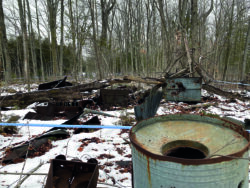
Among the cedars stood mature maple trees. Even more intriguing
was the discovery of an old sugar camp on the property. Previous
generations had produced syrup, though no one in his immediate
household had carried the tradition forward.
That discovery was enough. If it had been done before, it could
be done again.
INVESTING YOUNG
At just 14 years old, Alex purchased his first evaporator from CDL.
It was a modest 2’ x 4’ flat pan setup, but it represented something
much larger: ownership and commitment.
“I’ve always been a little entrepreneurial,” he explains. “It seemed
like something fun to do. Being able to make something.”
By 2016, he upgraded to a 2’ x 6’ evaporator and began thinking
beyond hobby scale. The shift was not simply about adding taps. It
was about building a system that could support long-term growth.
FROM BUCKETS TO STRATEGY
The operation evolved quickly. What started with buckets
progressed to tubing installations, vacuum planning, and carefully
considered equipment upgrades. Early purchases were about
making do. Today, purchases are made with expansion in mind.
Instead of temporary solutions, Alex invests in equipment that
supports where he intends to go. Stainless tanks replaced
improvised storage. A larger, expandable reverse osmosis system
replaced an entry level unit that quickly became undersized as
production increased.
That strategic thinking now allows him to run 2,000 taps efficiently
on a 2’ x 6’ evaporator. By concentrating sap to higher levels before
boiling, he has rebalanced the workload in a way that maximizes
both time and fuel.
Each upgrade has been intentional. Rather than buying for a single
season, he invests for multiple seasons ahead.
LEARNING THROUGH MISTAKES
Starting young offered one significant advantage the ability to
make mistakes on a small scale.
Rolling a tractor bucket full of sap once felt catastrophic. Burning a
pan during a heavy run was a stressful lesson. But those mistakes
happened when production volumes were manageable.
“Starting small meant I could fail small,” he says. “Now those lessons
won’t happen again.”
The setbacks sharpened his understanding of risk. They reinforced
the importance of washing pans properly, managing concentrate
levels carefully, and planning infrastructure ahead of expansion. What
felt overwhelming at the time became a foundational experience.
DAIRY AND MAPLE: A NATURAL FIT
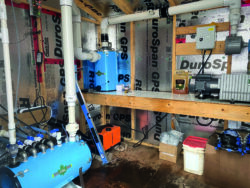
Although dairy and maple may seem unrelated, Alex sees strong
compatibility between the two. Vacuum systems, plumbing,
stainless welding, and mechanical troubleshooting translate
directly between operations. Both require consistency, attention to
detail, and a willingness to work regardless of weather or schedule.
Recent investments in a new dairy facility incorporate additional
technology designed to create efficiencies. That time savings
will be redirected toward maple expansion.
While dairy remains the family business, maple has become
something distinctly his own.
ADVICE FOR THE NEXT GENERATION
When asked what advice he would offer young producers
entering the industry, Alex returns to the importance of thoughtful
investment and long-term planning.
He encourages new producers to pace themselves, recognizing
that maple equipment is a significant financial commitment. At
the same time, he cautions against purchasing the smallest or
cheapest options if growth is clearly part of the plan. Equipment
that can expand alongside the operation often proves to be
the wiser investment.
He also emphasizes building tubing systems with future vacuum
in mind, even if vacuum is not installed immediately. Planning
infrastructure early can unlock major yield improvements later,
without requiring a full rebuild.
Above all, he stresses the importance of continuous learning.
Industry events, educational resources, and strong relationships
with equipment representatives have all played a role in his
development. Technical conversations that once centered
on basic installation now focus on system monitoring and
performance optimization.
The mindset has shifted from simply making syrup to refining
efficiency.
BUILDING TOWARD WHAT’S POSSIBLE
Right now, Alex is running approximately 2,000 taps, with most
of his syrup sold in bulk. But his focus is not just on volume. It’s
on efficiency.
Within five years, he would like to see the operation reach 5,000
taps. Within ten, 10,000 taps feels achievable. The investments
being made today, from upgraded RO capacity to improved
monitoring and infrastructure planning, are designed to make
that scale realistic rather than rushed.
Growth, for Alex, is not about chasing numbers. It is about building
systems that can handle them.
THE RUSH OF THE SEASON
What keeps him motivated is not only the growth potential, but
the intensity of the season itself.
Maple compresses months of preparation into a short window
of high stakes production. Long nights, constant monitoring,
and rapid decision making create a pace that he thrives on.
“There’s something about pushing for more,” he says. “How
much can we get, and how well can we do it?”
It is a question that defines both his present and his future.
Maple may not have been the family business he grew up in,
but it has become the one he is building for the future.
From 20 buckets in 2014 to a rapidly expanding operation today,
Alex Beaudette represents a generation that is not waiting for
perfect conditions or inherited infrastructure. They are learning,
adapting, and making calculated decisions early.
For Alex, the season is intense, the learning never stops, and
he is only getting started.