The Flavor of Syrup Made from Red Maple Sap

Red maple is an important species for maple production currently, and is projected to become increasingly
important in the future. Its presence in sugarbushes across the maple-producing regions of the US and
Canada contributes to the diversity of these forests.
Increase the resilience of these forests
to stresses like diseases and insects, but as an additional sap-producing species
the resilience of the maple operation as a whole is also increased. Red maple’s ability to adapt to and thrive in diverse sites andgrowing conditions also means that, unlikesugar maple, its abundance in forests of the maple-producing region is predictedto increase under future climate change scenarios, particularly in regions whereclimate conditions continue to enable theproduction of maple syrup.
PERCEPTIONS AND CHALLENGES
AMONG PRODUCERS
Despite its current and future importance
for forests and maple production, therecontinues to be hesitation among some
maple producers to include red maple asa crop tree. This stems from a persistentperception that red maple is an inferior
species for maple production, producinglower yields and/or syrup of lower quality.
However this perception likely originatedfrom anecdotal observations made with past practices, processing raw sapcollected in buckets, and there were nodata from scientific studies of red mapleyields or syrup flavor using currentcollection and processing practices (e.g.vacuum, reverse osmosis). To address this,we initiated a project to collect empiricaldata to assess the total yields and syrupflavor from red maple trees using modernsap collection and syrup processing
practices.
YIELD FINDINGS FROM PREVIOUS
RESEARCH
In a previous article in the CDL’S Way Magazine, we reported the results of theproject’s first study, in which we determined
that the total syrup yields of red mapleare identical to those of sugar maple when conditions are equal, as previouslydocumented in research from the Proctor Maple Research Center. However for theyields to be truly equivalent, the sap collected from red maples must alsoproduce syrup of equivalent quality asthat produced from sugar maple sap. If one or more of the primary beliefs about
the flavor of syrup made from red maplesap were true that it’s somehow inferior, or that late-season off-flavors (e.g. buddy,sève) occur earlier in the season or more frequently then the effective total yields would be reduced. Thus, an essential next step in this project was to investigate the flavor of syrup produced with red maple sap. We began this by examining the fundamental question is the flavor of syrup made from red maple sap different from syrup made from sugar maple sap?
SYRUP PRODUCTION METHODOLOGY
To answer this question, we conducted a study in which the flavor of syrup produced simultaneously from pure red
and sugar maple sap under identicalconditions was compared. Sap was collected separately under vacuum from
around 500 each red and sugar maple trees growing in the same stands at the University of Vermont Proctor Maple
Research Center. All components of the tubing systems were new. For each trial, the two types of sap were concentrated
separately to 8% and placed into separate
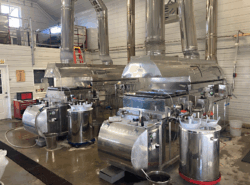
tanks which each fed one of two, identical 3′x10′ evaporators (Fig. 1). Concentrating the two types of sap to the same level
was essential to eliminate any effects that differences in their sugar concentration could have on the development of
flavor even a small difference in sugar concentration would result in a difference in the length of time necessary to process
the two types of sap in the evaporator, which could cause differences in flavor development between the two types of
sap. The evaporators were configured with identical burner and draft settings, liquid levels in pans, automatic draw-off
temperatures and settings, and quantities and location of defoamer addition. During each trial, the evaporators were started
simultaneously and run continuously until the supply of concentrate was consumed (~3.5hrs). Syrup from each was collected
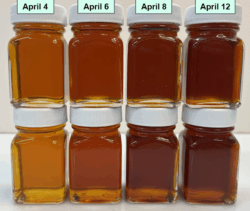
and filtered separately and frozen until subsequent analyses. The experiment was repeated on 4 days during the 2022
maple production season: April 4, 6, 8, and 12.
SENSORY APPROACH TO FLAVOR
EVALUATION
Triangle tests were conducted to determine if significant differences existed in the flavor of syrup produced
with red and sugar maple sap. These tests are a standard sensory method that is simple, yet very effective at detecting
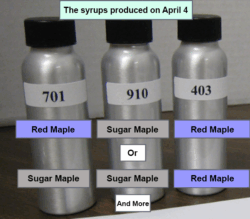
slight differences in flavor between two samples. Each panelist in the test is presented with three syrup samples
two are identical, and one is different. For example, to determine if a difference exists between the syrup produced with red and
sugar maple sap produced on April 4, each panelist receives a different combination of the two syrups produced during that
trial, two red maple syrups and one sugar maple, or two sugar maple syrups and one red maple (in a different order for
each panelist) (Fig. 2). The panelists are asked to taste all three syrups and identify which one is different from the other two.
If enough panelists correctly identify the “different” syrup, it can be concluded that there is a significant difference in the flavor
of that pair of syrups. These tests were
conducted for two of the pairs of syrup
produced during the experiment, the pairs produced first (April 4) and last (April 12). Twenty-two panelists with experience
tasting pure maple syrup participated in the tests. The flavor of pairs was considered significantly different (p < 0.05)
if 12 of the 22 panelists correctly identified the “different” sample.
RESULTS
Thirteen correct responses were given for the pair of syrups produced April 4, but only 9 were given for the pair produced
April 12 (Fig. 3). These results suggest that there likely is an inherent difference in the flavor of syrup produced with pure red and
pure sugar maple sap. However the results also suggest that this difference is quite subtle, because there was no difference detected in the pair of syrups produced April 12. This pair of syrup had a greater level of overall flavor development than
the pair from April 4, and thus the lack of difference suggests that these additional flavor compounds were able to mask any
inherent difference in flavor between the two types of syrup, indicating that any inherent difference was small.
The absence of a difference in the
flavor of the April 12 pair is of interest for an additional reason. This syrup was
produced very late in the season, after sap flow from trees had stopped and the daily high temperatures had been
warm (≥60 °F,15 °C) for several days. If late-season off-flavors appeared earlier
or more frequently in red maple sap, we would expect to detect a difference in the flavor of syrup made from red and sugar
maple sap at this time. The absence of a difference suggests that late-season off-flavors do not occur earlier or more
frequently in red maple sap. Overall, the results indicate that there is likely a subtle, inherent difference in the
flavor of syrup made from pure red and sugar maple sap, but that overall the flavor of the two syrups is very similar.
CONCLUSIONS AND FURTHER
CONSIDERATIONS
The overall results of this project have demonstrated that the fundamental syrup yields from red maples are very
good and not different from those of sugar maples, and that the flavor of syrup from both species is very similar. However
it’s important to remember that the two species are not the same. Red maples have their own unique requirements to ensure
their long-term health, regeneration, and that maximum yields over the longterm are obtained. This includes specific
tapping practices, silviculture and forest management practices, and the design and management of tubing and
sap collection systems and equipment (e.g. size of mainlines, tanks, reverse osmosis capacity, etc.). For a deeper
discussion of these factors and more detailed information on the studies of red maple yields and syrup flavor, additional
resources from this research team are available.
Acknowledgements
This work was funded by USDA AMS ACER Access Project (AM190100XXXXG069).
This article’s contents are solely the responsibility of the authors
and do not necessarily represent the official views of the USDA.