Your maple trees are not all the same… and that’s a good thing!

We all know it: no maple sugaring without healthy maple trees and resilient ecosystems. When we talk
about resilience in maple sugaring, we often talk about biodiversity, which is typically associated with
wildlife, habitats, or companion species but we sometimes overlook genetic diversity, the natural variation
within maple species themselves. This diversity directly affects very practical factors: sap yield, sugar
content, growth, and the ability to withstand late frosts or dry summers. In other words, it plays a direct
role in the resilience and productivity of your sugarbush.
In maple sugaring, we mainly work with sugar maple (Acer saccharum Marsh.) and
red maple (Acer rubrum L.), particularly in regions where maple sugaring builds
on long-standing traditions. That said, an important reminder: all species within
the Acer genus the broader maple family can be used to produce syrup, although
both quantity and quality may vary from one species to another. For our two main
players sugar and red maple several studies have generally shown comparable
yields and sap quality. For other maple species, there is no clear consensus on
their sugaring characteristics, yet they are often considered inferior. Whatever
their characteristics introducing invasive species (such as Norway maple, Acer
platanoides L.) is not a good idea, as they can hinder natural forest regeneration.
And having personally made syrup from Norway maple, it’s simply not worth it.
Each year, more than 60 million maple trees are tapped across northeastern
North America, and the vast majority come from near-natural stands rather
than plantations. This means that, as maple producers, you are working with
the genetic variability naturally present in your forests. Just like in a herd or most
other agricultural crop, not all individuals are the same: some produce more
sap, others have higher sugar content,
others heal better or are more resilient to environmental stress. Over time,
evolution can even lead populations to become distinct enough to be classified
as separate species. At the species level, sugar maple and red maple do not share
exactly the same strengths and limitations. For example, red maple can thrive in
wetter soils and generally adapts more easily to varying environmental conditions.
Beyond differences between species, there are also more subtle variations at
multiple scales.
At a local scale, two neighboring treesmay consistently produce different sap
volumes or sugar content within the same sugarbush. If you have ever tapped with
buckets, you will know this firsthand. At a regional scale, sugar maple populations
in Abitibi do not necessarily share the same characteristics as those in Kentucky.
Based on patterns observed in other plant species, Kentucky sugar maples are likely
better adapted to heat and summer droughts, while Abitibi sugar maples
should be more resistant to cold winters. That said, recent studies suggest that the
situation may not be quite so simple for sugar maple. One thing is certain: the more
we understand and maintain this diversity, the better equipped we are to adapt to
ongoing global changes.
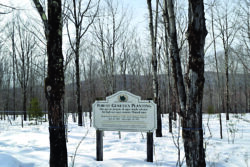
In the 1960s, genetic diversity in sugar maple was a major focus, and experimental
plantations were established to identify trees with higher sap sugar content, with
the ultimate goal of propagating these superior lines. One such plantation exists
at the Proctor Maple Research Center at the University of Vermont. In addition,
we have identified seven other genetic plantations established between 1958
and 1981 across the United States. Then technology changed everything: reverse
osmosis made sap concentration easier and more profitable. As a result, the pursuit
of “super sweet” maples slowed down, and genetic trials were largely left alone.
Today, 60 years later, interest in maple genetics is growing again. Even though
most tapped trees still come from natural stands rather than plantations,
understanding the genetic factors that influence performance and resilience
remains essential. Sugar content is only one piece of the puzzle. The real pressure
now comes from climate variability and pests: warmer winters, late frosts,
summer droughts, extreme rainfall, and emerging insects and diseases. At the
same time, expansion of maple sugaring is increasingly limited by access to new
sugarbushes, bringing yield per hectare back into focus. Genetics is not just about
Brix it also influences growth, healing, sap flow dynamics, and tolerance to
both climatic and biological stresses. Leveraging and better understanding
natural genetic diversity may becoming a key driver for sustainability, helping to
increase yields, stabilize production, and maintain healthy stands.
Progress is steady: we are gaining a better understanding of differences between
individuals and populations using modern scientific tools applied to sugar maple.
Since 2022, we finally have access to a complete genome for sugar maple
something still lacking for many other maple species. The sugar maple genome
contains 626 million base pairs and 40,074 genes. By comparison, the human genome
contains roughly half as many genes with around 20,000. Fortunately, there are ways
to simplify this complexity, and we can also learn from other plant species. We
are now revisiting earlier genetic studies and combining the historic data with new
genetic and field data on key traits. The good news: we already have several
simple tools at our disposal, along with genetic plantations that are now over
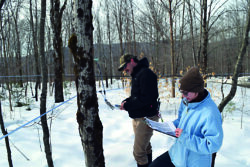
60 years old, where we have resumed measuring key seasonal events (first
sap flow, peak flow, end of season), sap sugar content, and growth rates. Think
of it as a puzzle with each observation adding a piece. The more reliable data we
collect, the better we can identify trees and practices that perform well under your
specific conditions.
In short, your sugarbushes are alreadyrich in genetic diversity. Recognizing,
monitoring, and, when appropriate, encouraging this diversity gives you a
better chance of achieving stable yields, maintaining tree health, and ensuring longterm
sustainability. In all cases, maple production depends on healthy trees
capable of producing sufficient sap and withstanding changing conditions.
In your sugarbush, a maple that is not a sugar maple or one that simply “looks
different” is not necessarily a problem. In fact, it can often be an asset. Resisting the
urge to systematically remove everything that does not match our mental image of
a “typical” sugar maple may help preserve valuable genetic diversity. Among these
atypical individuals may be trees that perform best under late frosts, future
droughts, or emerging pests. That said, this does not mean keeping everything
indiscriminately: consult a forest engineer or maple specialist to distinguish what is
truly problematic from what is simply different.